
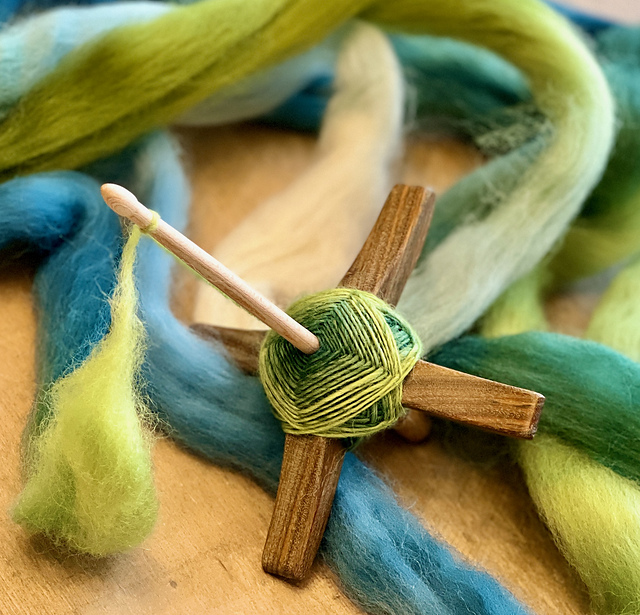
Limited success is still progress.
After my first semi failed attempt at spindle spinning, I decided to take another pass at it. I fell in love with a gorgeous Turkish glider spindle at the Estes Park Wool Market, so thought I’d give it a try. I can see how people get caught up in collecting these tiny engineering marvels. Anyway, I watched a bunch of how-to videos and then jumped in.
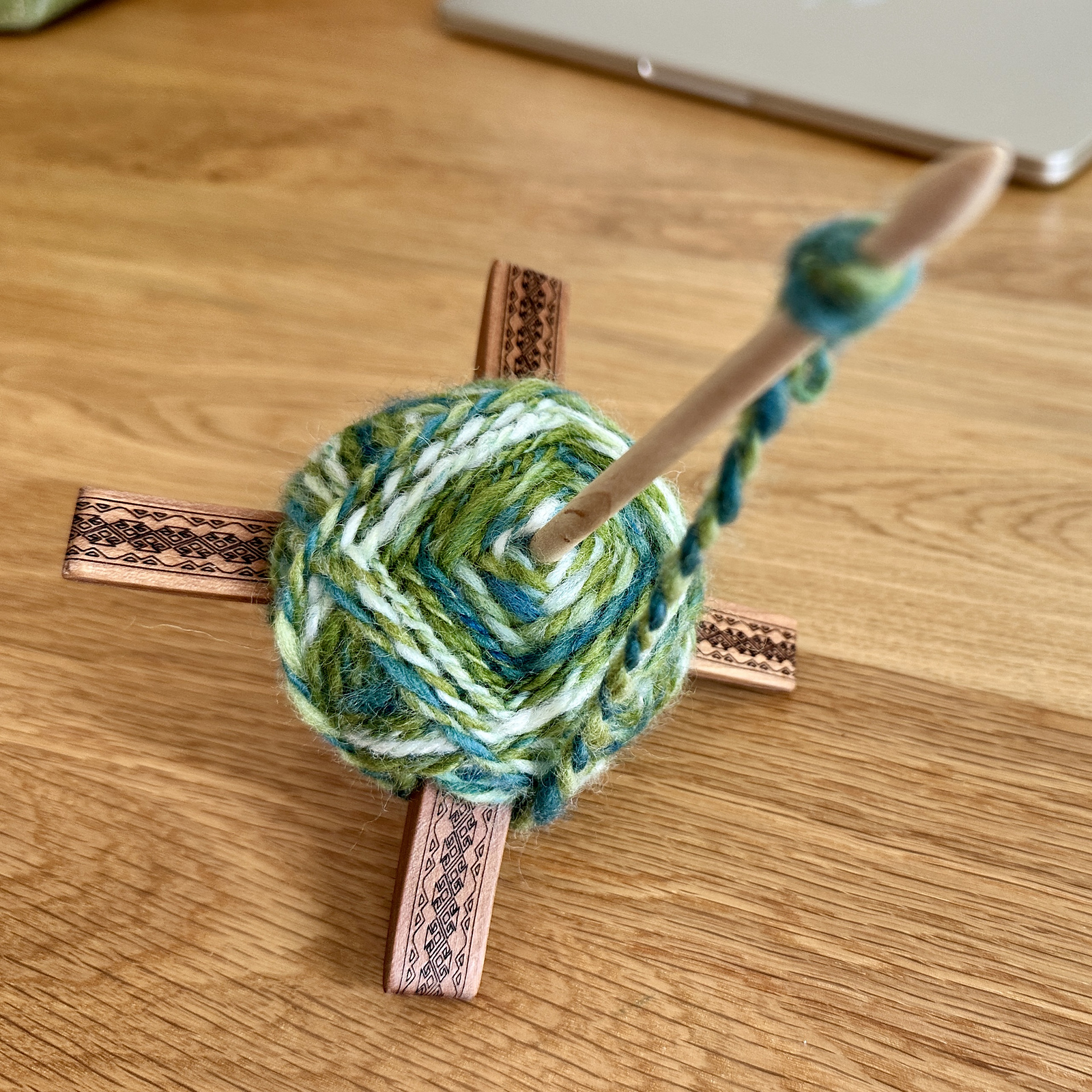
The lovely Turkish spindle itself is very smooth and balanced. They are bottom-whorl, or low-whorl, as opposed to top-whorl spindles. They have four arms that you wrap your spun singles around as you spin. The genius in Turkish spindles is that the four arms interlock and then slide onto the shaft. When you’re done spinning, you slide out the arms and shaft, and voila, you have a ready-made center-pull ball of yarn.
Part of the reason this works is the special way you wrap your spun yarn around the four arms. Once you have a length of yarn spun, you wrap it over two arms then under one. Then over the next two, and under the next one, over two, under one, and so on. The resulting “cop” or ball of yarn is sometimes called a turtle, because it looks a bit like a turtle with its legs sticking out.
This fancy wrapping helps to keep the yarn tidy and untangled. The over-2-under-1 winding pattern also looks pretty, especially with a variegated yarn. It’s a little tricky to do at first, but gets easier with practice. I didn’t think I would have the patience to wind the cop in this fancy way, but it is somehow strangely compelling and soothing. The process is slowwww… but it’s more about the journey than the destination. It strikes me as being like a fidget spinner (which I love) that has an additional, practical purpose.
For this project, I selected a plain Corriedale fiber so I wouldn’t have to adjust for multiple staple lengths while learning. It’s easy to draft and the colors were like cool water, which is especially nice because it was 100 degrees F here. I split the fiber in half lengthwise, and then in half again, which seemed about right. The spinning itself was very slow going. I got this far… and then stopped. For two years. I’m glad fiber is patient.
When I was ready to try again, my spindle still had the first batch of fiber on it from two years ago, and I thought the twist in it might be dead. But I (very unevenly) spun a bit of leftover fiber drafted straight across the top, then plied what I had, and it actually worked. I set that first cop aside and started a new batch using some rolags, which did indeed make it easier to spin, if a bit fuzzier.
When the second turtle got to a decent size, it was time to ply. I got a larger/heavier glider spindle for plying so it would hold the twist.
Plying this second turtle was problematic. Typically you ply from both ends of the center pull ball, which in theory should work well. For me, the center pull ball quickly turned into a huge, incredibly frustrating mess. I had to cut a couple of sections out because the knots were so bad. I don’t know what I did wrong, but if this happened to everyone, nothing would ever get plied. I’m sure it’s user error. But after hours of frustration and and judicious use of tiny pointy scissors, I ended up with a pretty decent little 2-ply turtle.
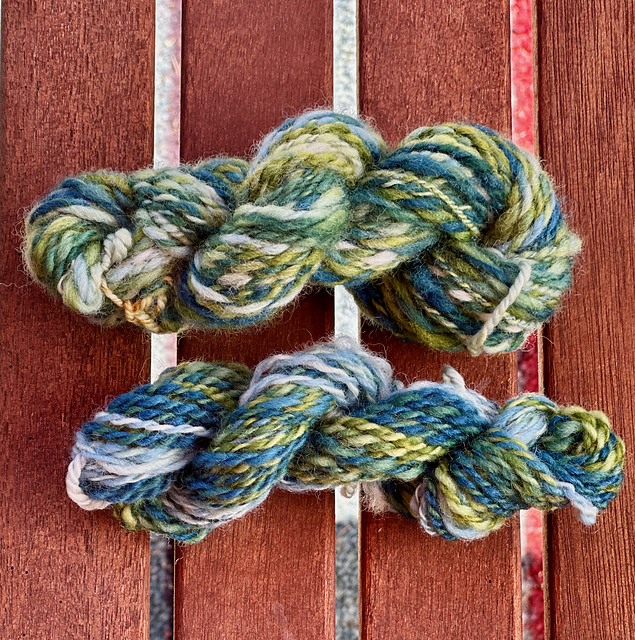
I wound off both the initial yarn and the new yarn, measured it, and finished it. The yarn behaved a lot better once it was plied and finished. In the photo below, you can see that the top skein (woolen prep) is thicker and fuzzier than the bottom one (worsted prep) because there’s more air in it.
Overall I am pretty pleased with the result, despite the frustrations I encountered. I know I need more practice to get good at spindle spinning. But for a total of less than 45 yards, I can’t see how this is a practical way to spin. I may have to view it as a creative outlet and something to keep my hands busy rather than making enough yarn to knit with.
Leave a Reply