Spinning woolen after years of worsted is… an adjustment.
My Tour de Fleece goal this year was learning a completely new technique: longdraw on the spinning wheel. While researching this in preparation, I learned that longdraw is a woolen-spun technique. With woolen spun, the fibers aren’t aligned perfectly so you get a lot of air in the spin, as opposed to the smoothness and consistency of worsted-spun yarn. The most succinct definition I found was in Knitty.com’s Glossary entry for Spinning Woolen-style Yarns. There’s a lot there (I recommend reading it) but this made my wannabe English major heart happy:
If woolen and worsted were poems, worsted would be a sonnet and woolen would be free verse.
The Fiber
For woolen spinning techniques, you want a fiber prep that is also woolen and airy and somewhat chaotic. A skilled spinner can do longdraw with combed top, but because the fibers are all neatly aligned, it’s harder to get fluffy yarn out of it. When digging through my stash, I realized that all of my fiber is combed top, but I looked for something that might work. As a beginner, I didn’t want to start with fiber that has multiple staple lengths, such as a wool and silk blend, so I selected a braid of soft, crimpy Apothefaery Montana Corriedale to learn on. I’d already used a bit of this for spindle practice, but there was plenty left for learning longdraw.
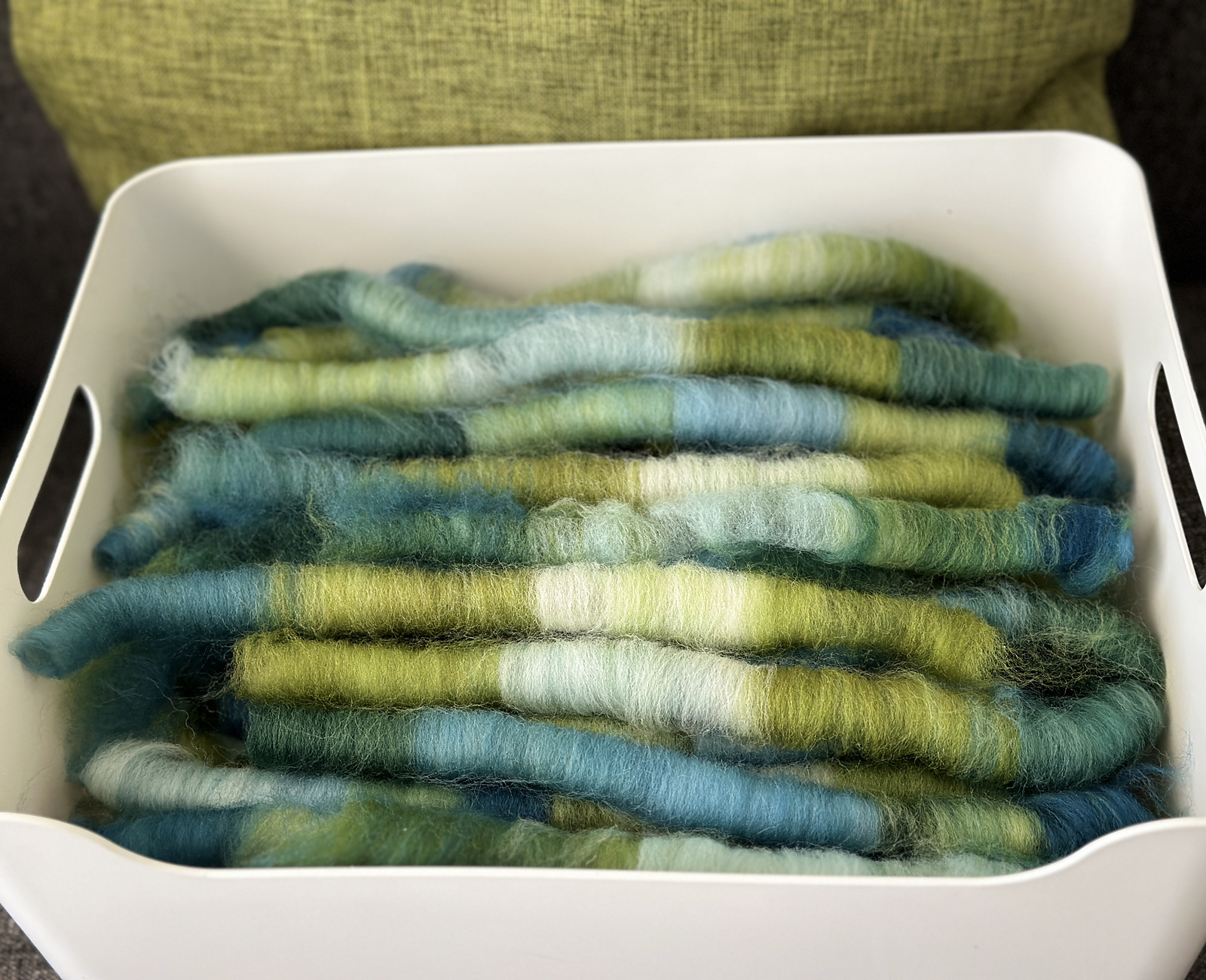
One woolen prep option is making batts on a drum carder, but drum carders are expensive and take up a lot of room. But making rolags, airy tubes of fiber that you spin from the end, is more accessible. You can make them on hand carders, or make fauxlags (which are super cool), but both methods seemed like it would take forever to make any substantial quantity. As a happy medium, I got a blending board so I can transform any of my combed top stash into rolags.
One night I sat down with this slab of wood covered in pointy, pokey pins — not exactly recommended for a clumsy person like me — and spent the evening figuring out how to make rolags with the Corriedale. There was a bit of a learning curve involved in determining how much fiber to lay down to make it hold together, and how to draft it together with rods at the bottom. But it turned out to be a good thing to do with my hands while watching a movie, and I only scraped my knuckles on the pins once.
The Technique
Armed with my newly acquired knowledge and my bin of rolags, it was time to give longdraw a try. I watched/read Schacht’s free Long Draw Spin Along course starring the fabulous Stephanie Flynn Sokolov, and that gave me the confidence to get started. As suggested, I began with medium-ish woolen backward draw, maybe 6 inches or so. After spinning short forward or backward worsted for five years, letting go of control and trusting the yarn not to fall apart was really, really hard! I very awkwardly began to let the twist into my fiber hand, but it was very on-and-off, no flow. Sometimes my fiber releases felt like I was plucking a wooly guitar string, which didn’t seem like it could possibly be right. I knew my pinch was too tight but felt like I needed the pressure to draft my fiber supply against. I did get some fuzzy, if very uneven yarn, though, so at least the woolen part was working.
Before working on it again, I read the amazing Jillian Moreno’s Sample Along: Supported Long Draw and watched the accompanying video. Once I started using a rhythmic, gentle pinch-and-release with my forward hand, I was able to draw the fiber in my other hand further and further back. Pretty soon I got in the groove and started doing that gentle pinch-and-release with my fiber hand too. That first lonnnnnng draft felt like magic! I can do this! The yarn somehow held together, and started to feel stretchy between my hands. It was surprising how fast I plowed through the rolags, just practicing. I broke my yarn a few times, but that got easier once I backed off on my spinning wheel tension.

As you can see, my singles were inconsistent AF, with both chunky and threadlike spots. But they were mostly floofy and airy, and evened out a bit when plying. I still very much need my forward hand, so it’s a supported longdraw at the very least, but it’s definite progress.
One thing I have to work on specifically is my sitting position. Both of the above mentioned teachers were very clear about sitting square with your wheel and not twisting your back, but I found myself twisting around without realizing it. Fortunately, I can easily tilt the flyer head on my Majacraft Rose to the left or right. I tried left first and that was terrible. But when I moved the flyer to the right, success! Having the right tools for the job is amazing.
The Finishing
I chain plied the singles, primarily because I hadn’t split my spinning across two bobbins to have it already set up for 2 ply. I was a little afraid to rewind my singles onto two bobbins because I wasn’t confident that the loosely-spun singles would hold together.
After letting the plied yarn rest, I wet-finished using Stephanie’s suggestion to gently felt the yarn. This involved soaking in very hot water and then rinsing in very cold water. I repeated this a few times, then blotted, snapped, and thwacked the skein hard on the kitchen counter. This was my first experience with thwacking, and after finding a place where I wouldn’t hit the refrigerator or the light fixture with my wet yarn, it was very cathartic. I might need to thwack my yarn more often.
The Results
My finished yarn is 90 yards of chain ply at 6-7 WPI, making it on the thick side of bulky weight. It did fluff up a bit after the felting treatment. I very much like the loft and floof level, despite its unevenness. I can’t really tell whether I successfully semi-felted it, but that may be come more apparent when I knit with it.
When learning to spin longdraw, I didn’t expect to learn so much about woolen vs worsted fiber prep, woolen vs worsted spinning techniques, and the properties of the resulting yarn. It’s a little confusing, but easier when you can see and feel the yarn IRL. I also learned that due to all the air trapped in the floof, woolen yarn is warmer and more prone to pilling than worsted. I think the result of my first attempt at longdraw is destined to be a warm and cozy hat.
The following bit is somewhat technical and probably only of interest to spinning nerds who are deep into the rabbit hole. Feel free to skip if you like.
What’s really interesting is comparing it to other yarn I’ve spun.
The photo below at left compares this longdraw yarn (top skein) with spindle-spun and plied yarn from the same fiber. On the bottom left is 2-ply spun from rolags, and on the bottom right is the same but spun worsted, straight off the top of the combed top.
The photo below at right compares the longdraw woolen prep / woolen spun with my usual worsted prep / worsted spun. The worsted yarn is definitely smoother and denser, yet somehow has a significantly higher grist (about 200 more yards per pound).
It also looks like the chain ply (top) may have tamed some of the woolen floof compared with the 2-ply spindle spun from rolags. This could be from overly aggressive chain plying, the increased tension of the wheel, and/or the fact that my very inexperienced spindle plying from a center pull ball resulted in a horrific tangled mess that took me hours and judicious use of very pointy scissors to straighten out.
Leave a Reply